Keyenberg belongs to four other villages
to the last major resettlement phase
for Garzweiler II
Keyenberg has 820 residents. The location, along with Kuckum, Oberwestrich, Unterwestrich and Berverath, will be relocated to a new location north of Erkelenz by around 2027. Keyenberg is the village closest to the opencast mine and is expected to be used for mining around 2027.
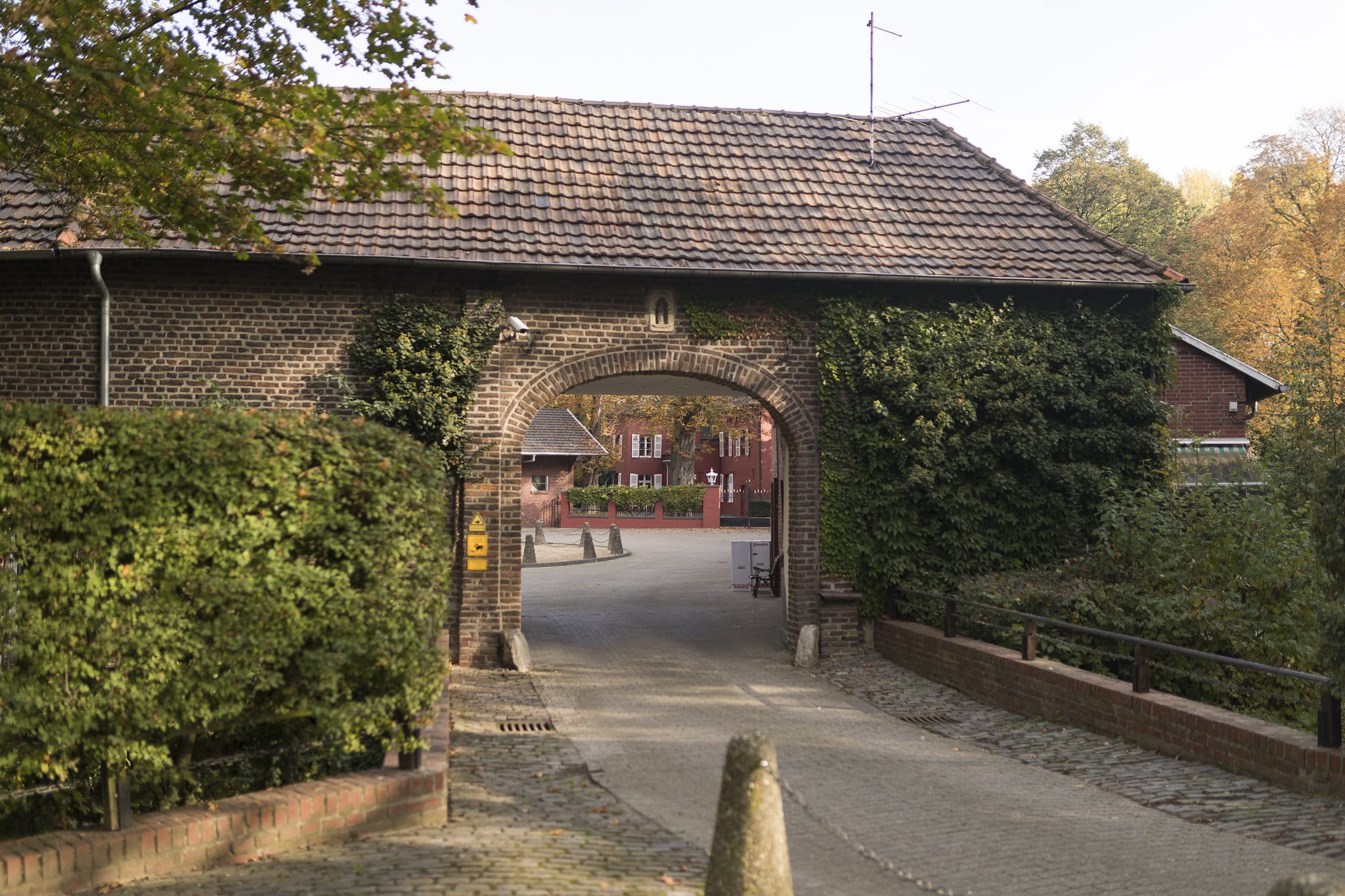
The defining buildings of Keyenberg are the church Heilig Kreuz in the center of the town and the house Keyenberg.
Village life is already moving to the new town north of Erkelenz, and the first shooting festival will be celebrated there in 2020.

Resettlement timeline: Keyenberg, Kuckum, Oberwestrich, Unterwestrich & Berverath
16.09.2010
Planning of the resettlement becomes concrete
The lignite committee decides to have two lignite plans drawn up for the coming resettlement section (Keyenberg, Kuckum, Oberwestrich, Unterwestrich, Berverath), one for Keyenberg, one for the remaining locations. This means that residents have the opportunity to decide whether the five places want to relocate together or in two separate procedures.2010 to 2012

A resettlement location is being sought
A resettlement location is sought in a process involving the local population. For this purpose, seven search spaces will be defined, which will be presented and discussed in public workshops.25.11.2012

Choice of new location
On November 25, 2012, the residents of the five villages will choose the location of their new village in a secret ballot: Erkelenz-Nord. Of the 1,345 eligible voters, 874 voted, which corresponds to a voter turnout of 63%. 564 voters chose the Erkelenz-Nord location, which is 66.7%.2012 to 2015

Planning the new location
The design of the new location is being fleshed out in various citizen forums and surveys.09.04.2016

Start of construction new Keyenberg
The groundbreaking ceremony for the new location took place in April 2016. Construction of the town's infrastructure begins in May: canals, lines, roads, etc.01.12.2016

Start of resettlement
Start of joint relocation of Keyenberg, Kuckum, Oberwestrich, Unterwestrich and Berverath. The residents of the villages therefore have “resettler status”.23.03.2018

Draft church presented
The plans for the new church of Neu-Keyenberg are presented. This new building replaces both the churches of Keyenberg and Kuckum as well as the chapel of Berverath. Elements of the old buildings should be reflected in the new building: parts of the windows, individual furnishings and stones from the masonry. Construction began in summer 2020. Photo: Dewey & Blohm-Schröder Architect.16.09.2019

Churches sold
The churches of Keyenberg and Kuckum and the chapel Berverath are sold by the parish of Christ the King to RWE. The “All Villages Remain” initiative had collected 3,000 signatures against the sale of the church.approx. 2022 to 2027

Demolition of Keyenberg
According to current planning, the Keyenberg opencast mine will reach around 2027.approx. 2022 to 2027

Demolition of Kuckum & Westrich
According to current planning, the opencast mine Kuckum, Ober- and Unterwestrich will reach around 2027.approx. 2022 to 2028

Demolition of Berverath
According to the plans at the time, the opencast mine was expected to reach Berverath around 2028.
All graphics/maps in the timeline: City Erkelenz


Alexander Tetzlaff
Alexander Tetzlaff grew up in Keyenberg until he was thirteen. His family then had to give up their house for personal reasons and move away from the town. After his studies, Alexander moved back to Keyenberg with his then girlfriend and now wife. What is remarkable is that the resettlement was already imminent at this point, so Alexander knew that he would soon have to give up his place of residence again.

Please introduce yourself.
My name is Alexander Tetzlaff. I grew up in Keyenberg until I was 13, then I moved away with my parents because we could no longer keep the house in Keyenberg for personal reasons. My father became ill and my mother wanted to return to her hometown in Korschenbroich. I then lived in Kleinenbroich, to name the place, until 2012, when I started studying. I then studied religious education, which means I am also employed by the church.
After completing my studies, I decided to return and then moved to Keyenberg, Alt-Keyenberg with my current wife, who was still my girlfriend at the time, with the clear awareness that I wanted to help shape this process. I have also been involved in the clubs before, I was part of the brotherhood from a young age, I have been the brother master since last year and I have been the second brother master, i.e. deputy, since 2014.
That's my big baby here in town, to support this club and live for it and to see that the brotherhood as a club, or the clubs in general - I'm also active in the carnival club - is strengthened and consolidated. Whenever something comes up, I think it's very good because it enlivens village and local life and that's kind of my goal to help shape it.
I am very proud to have been elected to such a position here in Keyenberg as a 25-year-old. The fact that the Keyenberger brotherhood wanted and supported this is a very good sign for me, because tradition has to be rethought again and again and we have to take new paths in order to remain attractive, that's for sure.
What is a shooting brotherhood?
They were founded in our region in the Middle Ages, in the early to late Middle Ages. The Rifle Brotherhood was intended to create a social structure alongside the church community; it was, so to speak, a social association of people who made sure that, for example, the members received a proper Christian burial, especially those who were not so wealthy and would not have received a dignified burial.
On the other hand, there is an aspect, the protection of the homeland, which is of course very sensitive in relation to our current situation. But they were, so to speak, citizen militias that banded together to defend their homeland in the event of an attack or something similar. In the late Middle Ages, when the defensive character was no longer so important because the weapons and the system had changed, so-called mercenary troops emerged who fought for the nobles, for the high lords, and helped defend the places that were part of their fiefdom.
As a result, the brotherhoods have shifted somewhat into church-religious life. The time of the Reformations also plays a major role. It is proven that there has been a Protestant community here in Otzenrath since the 16th century. During the Thirty Years' War, the Rifle Brotherhood from Borschemich was called to help by the Otzenrather Catholics at Corpus Christi because the Protestant Christians in Otzenrath tried to attack the Corpus Christi procession and desecrate the hosts. The shooting brotherhood then rushed to help and ensured protection and order.
What is brotherhood for me today? I would like to bring the term into the present day. Our motto is: “For faith, customs and home!”. Nowadays, home plays a very important role, for us in our situation anyway. I think brotherhood is there to offer a home. We have to think outside the box when it comes to this term, we can't just think in terms of location. I've often had this thought about the whole refugee issue etc. As a brotherhood, we have this on our flag and it is actually one of our tasks to offer these people a home. To reach out to people who want to come and belong to a community.
We help shape local life, once a year the shooting festival takes place for three days, this comes from very old traditions. A shooting brotherhood is also a party club, of course. There is always this accusation: 'You are nothing more than summer carnivalists'. I always say, yes, that’s true. I'm also active in carnival, for me the one thing that comes with summer is celebrating, meeting up and being out and about with people. The other thing belongs in the winter, it is a social club.
How do you as shooting brothers deal with the current situation?
That's very difficult, it also opens up gaps. I think a club like this has to endure such trenches. As chairman, I also find it difficult to position myself. I can only talk about what concerns me personally, how I see it personally, I don't want to transfer that to the club or pretend anything.
What is my personal opinion and what is important to me is to emphasize that a part remains of our homeland and that is us humans and we humans can create, we humans are designers. This home that we are now losing was shaped by people over centuries and there will be a new home. There may be potential for this new home to be redesigned over the centuries. I think it's a break, but it goes far beyond that.
The idea of continuing to offer a home beyond that and to take what we can take with us from our home and to protect and care for it also plays a role.
To cultivate togetherness, that people meet, the individual shooting groups, that they understand each other, that at some point there will come a time when RWE is not the only topic at the shooting festivals. When celebrating locally, we also have to protect ourselves as people so that things will work again at some point. That you can breathe a sigh of relief again and say, we still made it. Our home remains home because I know on the corner of A piece of the old place remains.
What defines Keyenberg for you?
The main thing about Keyenberg is that it is a village that has incredible character. There is hardly a village that has so many courtyards lined up next to each other, such as a town center. Not much was destroyed here during the war and a lot was modernized after the war. There are some farmhouses that suddenly have 70s tiles on the walls, that just happened, that was the taste of the time, that also defines the character.
Keyenberg also notices when you walk around, i.e. across the meadows, across the field paths, that everything is not so straight, there is not one house next to the other and each one is the same, but everyone has added their own part somewhere. Keyenberg is a cottage industry if you look behind the houses, behind the facades. I just find it very homely and very beautiful.
What's also important to me since childhood is that Keyenberg is one of the places where there is a piece of forest. Children can go into the forest and build tree houses and dig trenches and then play as they please and imagine that they are building a knight's castle and attacking each other or something like that. That was simply what it was all about in childhood and I still say today that I think it's nice to go back to places like that and say, you can still remember experiencing this and that here as a child.
What makes Keyenberg different, and that's where I come back again, is the people. I think it's very important to have a feeling of togetherness. Meeting the people you are friends with again and again, drinking a beer together, talking and sharing joys and sorrows with each other. I think that just as it is part of the joyful celebrations, it is also the case that the sad things, for example when a funeral takes place, are where these people come together and then talk to each other.
The end of brown coal is currently being discussed again. How do you feel about this?
In terms of my inner attitude when it comes to the benefits of open-cast brown coal mining, I am clearly a supporter of the protests. I think it's great that the Hambach forest was saved, no question about it. That's my opinion. Our current problem is simply that the resettlement has begun and that I would like it if perhaps the entire area was not excavated. I would rather stop. It is also very clear that brown coal must be phased out as an energy source.
This is simply too late for Keyenberg. For Keyenberg as a place that we are now trying to save at all costs, so if you go to the new location, the first 40-50 houses are already there. I know of a lot of those that are currently being planned that will be gone over the next year. That's a problem, we won't be any happier if we stop the resettlement process here now. As harsh as that sounds and I'm frightened of myself, we said A, or A was said... On the other hand, you have to make it clear that we are still not leaving voluntarily, but we are being forced. But now A has been said and we have to say B too. If we want to continue surviving as Keyenberg.
That's what some people might not understand, when I talk about Keyenberg, I'm talking about the people, and everything else that makes up Keyenberg, besides the cultural monuments. Of course it is a shame that this church will no longer be here in a few years. Of course it is a shame that brown coal is being burned at a time when we are actually much smarter and know that it is not good for the environment. On the one hand, I see this politically in the same way as the opponents of opencast mining in the Hambacher Forest, but on the other hand, I am affected as a resettler and cannot overcome this gap.
How frustrating is it to be one of the last places to be excavated?
It was frustrating from the start; up until the policy decision in 2015, I was still vehemently hoping that things would turn out differently. Many people here were already resigned, but I was one of those who said that the A61 would be over, that Borschemich would be the last - what would they have done with Immerath? Flat and then probably nothing more.
I often think that it was RWE's desire to empty a place that is already on the other side of the A61 as quickly as possible so that they have an argument to go over the A61. That's what I've often had the feeling that it was a political means to pursue a goal. The fact that Immerath was relocated so early and so quickly actually makes no sense given the course of the opencast mine. That's what I'm complaining about, to be honest. If Immerath hadn't been relocated so early, we would have had a good chance, because Holzweiler remains standing. I ask myself why only this one village remains standing, why didn't they say that we'll leave what's still outstanding.
Last shooting festival


House Keyenberg


New-Keyenberg
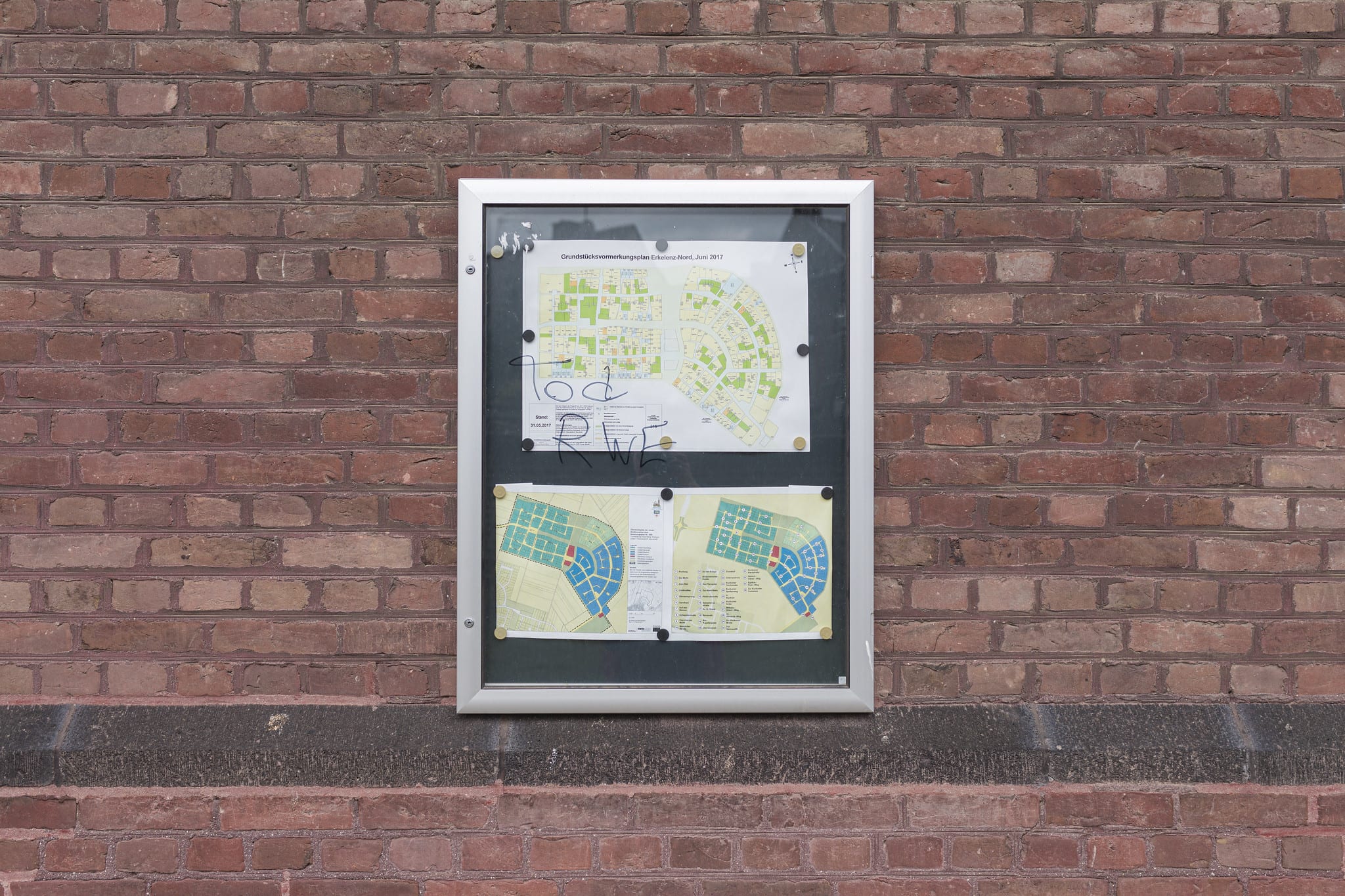
Keyenberg, along with Kuckum, Oberwestrich, Unterwestrich and Berverath, will be relocated to North Erkelenz, immediately adjacent to Borschemich (new). The new location will be structured in such a way that the old locations should remain recognizable, for example through structural separation.
New Keyenberg has been under construction since 2016 and in 2021 dozens of buildings have already been built and inhabited.

Twelve villages will be demolished for opencast mining
Five villages have already been completely destroyed, one has almost nothing left and six others are currently being relocated. Two to three individual farms, the final mining limit is not yet entirely certain, will be relocated towards the end of the opencast mining.
Select locations on the map · Historical planning status · Move map sideways

Holz (old)
† 2008
Pesch (old)
† 2014
Otzenrath (old)
† 2007
Spenrath (old)
† 2013
Borschemich (old)
† 2017
Borschemich (old)
† 2017
Keyenberg (old)
† approx. 2026
Lützerath (old)
† approx. 2022
Immerath (old)
† approx. 2022
Kuckum (old)
† approx. 2027
Unterwestrich (old)
† approx. 2027
Oberwestrich (old)
† approx. 2027
Berverath (old)
† approx. 2028
Immerather mill
† 2018
Immerather Dom
† 2018
Church Keyenberg
† approx. 2024
Eggerather Hof
† approx. 2030
Roitzerhof
† approx. 2035
Weyerhof
† approx. 2035
Otzenrath (new)
* 2001
Spenrath (new)
* 2001
Holz (new)
* 2001
Immerath (new)
* 2006
Keyenberg, Kuckum, Westrich & Berverath (new)
* 2016
Borschemich (new)
* 2006
All locations and times as a list
Holz (old)
† 2008Pesch (old)
† 2014Otzenrath (old)
† 2007Spenrath (old)
† 2013Borschemich (old)
† 2017Borschemich (old)
† 2017Keyenberg (old)
† approx. 2026Lützerath (old)
† approx. 2022Immerath (old)
† approx. 2022Kuckum (old)
† approx. 2027Unterwestrich (old)
† approx. 2027Oberwestrich (old)
† approx. 2027Berverath (old)
† approx. 2028Immerather mill
† 2018Immerather Dom
† 2018Church Keyenberg
† approx. 2024Eggerather Hof
† approx. 2030Roitzerhof
† approx. 2035Weyerhof
† approx. 2035Otzenrath (new)
* 2001Spenrath (new)
* 2001Holz (new)
* 2001Immerath (new)
* 2006Keyenberg, Kuckum, Westrich & Berverath (new)
* 2016Borschemich (new)
* 2006
More images from the original page