DOKUMENTATION GARZWEILER

A photographic documentary by Arne Müseler

Berverath

Probably the last of the
Village affected by open pit mining Garzweiler

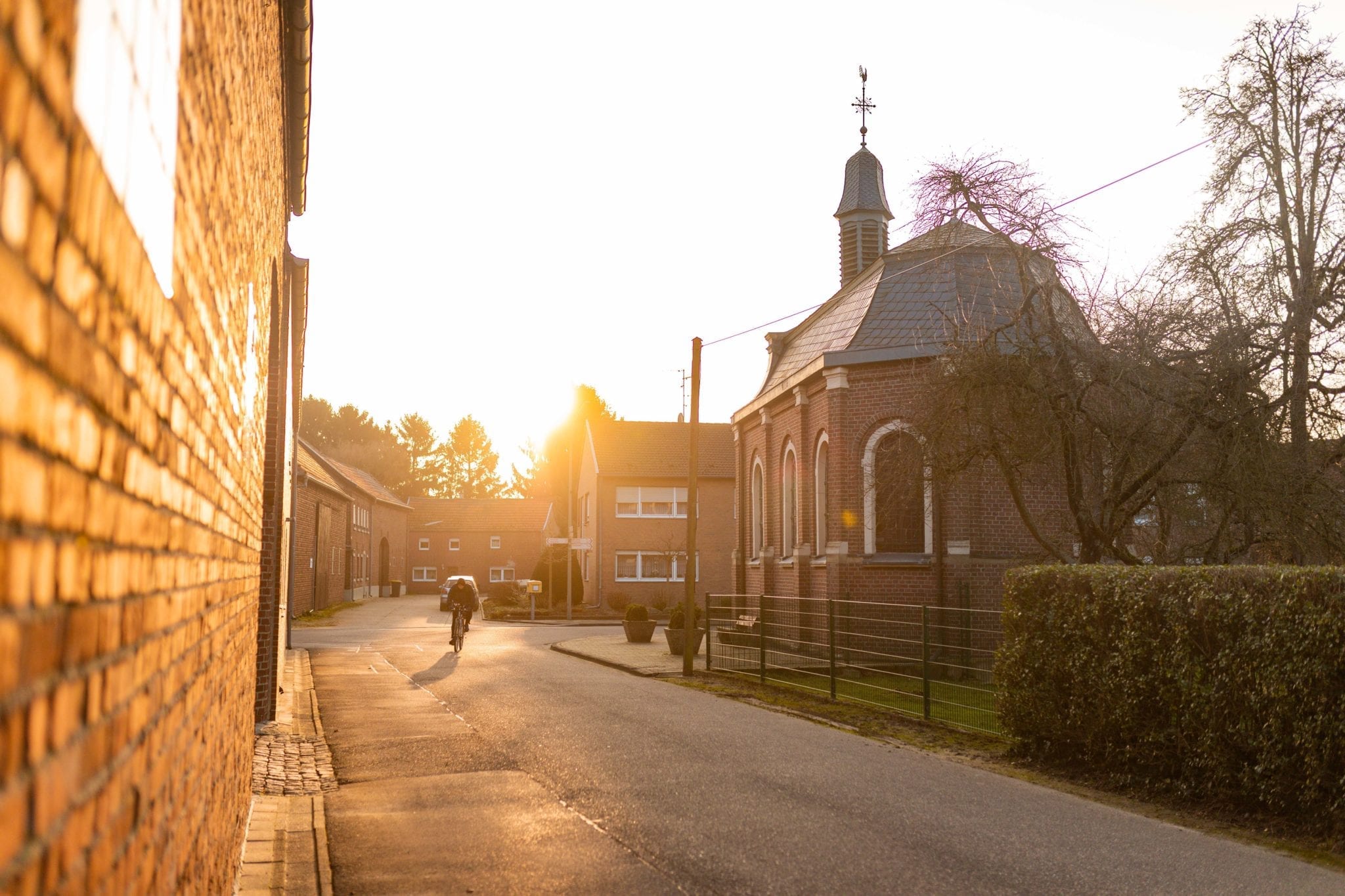
The small village of Berverath is located east of Erkelenz in the middle of the future mining area of Garzweiler II. The joint relocation of the village together with Keyenberg, Kuckum and Ober- and Unterwestrich began in 2016 and is scheduled to be completed in 2028. According to current planning, the opencast mine will reach Berverath around 2030.
Berverath is very rural. Five courtyards from the 18th and 19th centuries are listed buildings. Other monuments in Berverath include a wayside cross and the chapel from 1909 in the center of the village.

Timeline Resettlement Berverath, Keyenberg, Kuckum & Westrich

Timeline · scroll horizontally

  1. 16.09.2010

    Planning of the resettlement becomes concrete
    The lignite committee decides to have two lignite plans drawn up for the coming resettlement section (Keyenberg, Kuckum, Oberwestrich, Unterwestrich, Berverath), one for Keyenberg, one for the remaining locations. This means that residents have the opportunity to decide whether the five places want to relocate together or in two separate procedures.
  2. 2010 to 2012

    A resettlement location is being sought
    A resettlement location is sought in a process involving the local population. For this purpose, seven search spaces will be defined, which will be presented and discussed in public workshops.
  3. 25.11.2012

    Choice of new location
    On November 25, 2012, the residents of the five villages will choose the location of their new village in a secret ballot: Erkelenz-Nord. Of the 1,345 eligible voters, 874 voted, which corresponds to a voter turnout of 63%. 564 voters chose the Erkelenz-Nord location, which is 66.7%.
  4. 2012 to 2015

    Planning the new location
    The design of the new location is being fleshed out in various citizen forums and surveys.
  5. 09.04.2016

    Start of construction new Keyenberg
    The groundbreaking ceremony for the new location took place in April 2016. Construction of the town's infrastructure begins in May: canals, lines, roads, etc.
  6. 01.12.2016

    Start of resettlement
    Start of joint relocation of Keyenberg, Kuckum, Oberwestrich, Unterwestrich and Berverath. The residents of the villages therefore have “resettler status”.
  7. 23.03.2018

    Draft church presented
    The plans for the new church of Neu-Keyenberg are presented. This new building replaces both the churches of Keyenberg and Kuckum as well as the chapel of Berverath. Elements of the old buildings should be reflected in the new building: parts of the windows, individual furnishings and stones from the masonry. Construction began in summer 2020. Photo: Dewey & Blohm-Schröder Architect.
  8. 16.09.2019

    Churches sold
    The churches of Keyenberg and Kuckum and the chapel Berverath are sold by the parish of Christ the King to RWE. The “All Villages Remain” initiative had collected 3,000 signatures against the sale of the church.
  9. approx. 2022 to 2027

    Demolition of Keyenberg
    According to current planning, the Keyenberg opencast mine will reach around 2027.
  10. approx. 2022 to 2027

    Demolition of Kuckum & Westrich
    According to current planning, the opencast mine Kuckum, Ober- and Unterwestrich will reach around 2027.
  11. approx. 2022 to 2028

    Demolition of Berverath
    According to the plans at the time, the opencast mine was expected to reach Berverath around 2028.

All graphics/maps in the timeline: City Erkelenz

The Berverath chapel was built in 1909 by Joseph Jansen on his private property. On May 6, 1912, he donated his chapel to the parish Keyenberg, which accepted this donation in August 1913. From 1921, masses were allowed to be held in the chapel.

Berverath will be relocated together with Keyenberg, Kuckum, Oberwestrich and Unterwestrich and will not have its own chapel at the new location. Instead, a community church for all five villages will be built. The round window above the entrance and the baptismal font are probably taken from the chapel Berverath.

Britta Kox

Britta Kox only moved back to her parents' house in Berverath in 2015. She was born in Immerath (old) and grew up in Berverath. She is convinced that there is still a chance that Berverath and the other places could be saved.

You can find another part of the interview on the page “How does resettlement work?”.

Please introduce yourself.

My name is Britta Kox. I am 47 years old and we are here in Berverath in my beautiful house with a beautiful garden. I was born in Immerath, in the hospital, like almost everyone of my generation. I've always lived here, spent my entire childhood and youth here, but moved away when I was 18. That's how it goes, you get to know someone, you move out, you stay away for a while. In the end, I moved eight times and always returned to Berverath - I moved back four times. The last time was in 2015, when we moved here completely with the children and said: “So, now we’re staying, we want to stay and we’re not taking another step away from here.”

When you moved here, it was already clear that Berverath would be demolished. How did this decision come about?

In that sense it was a conscious step because my parents simply no longer had the strength. My parents no longer had the strength to continue living here; They always lived here and then at some point they said: "Good, now it's Sense. We can't go any further. It's too much for us here. The house is too big for two people." We were looking for something new for our family of six and my father said: "Well, then you move in there and we move away and you keep fighting for us and you take care of it and do the negotiations with RWE, if that's the case. You have more strength than us." And that was the main reason. We then said to ourselves: “Okay, for ten or twelve years, thirteen years in the end, we will still have a nice life in this place where I was born and my children can still experience everything that I experienced here back then.”

What is your connection to Berverath?

So my connection to this place is easy to explain: we have been there for centuries. My whole family has always lived here. My great-grandmother lived here in this house with fourteen children and rebuilt the house alone after the war and she created a protective roof for us, a home, and that is also one of the reasons why I say this house has soul. So many people from my family have lived here. The house has soul; the whole village has soul. We played here a lot as children. We had gangs here. The upper village and the lower village fought each other, fought playfully. There were treasures that were buried, that were stolen by the other group and yeah, those are just things you don't want to let go of. Every house has some memory. When I walk through the village here, every house is full of memories. As soon as I see this house, I know that I've done this and that, I've managed to get through the farmer's rent and these are things that I don't have in the new place, that I only associate with here. Friends of mine lived in Keyenberg and Immerath, and I also went to school in Immerath. Behind the church in Keyenberg I kissed my husband for the first time. I was there this morning and saw the corner again and it brings back so many memories; Memories that are torn away from you and a lot of memorabilia have already disappeared and I don't want to see any more disappear.

How are people in the new places?

Yes, it's twofold. Some say, “Okay, I’ve put it behind me.” They say: "Okay, I've come to terms with the new thing," but voices keep coming up, especially from older people, who say: "At the beginning it was like a vacation and at some point you feel like you want to go home again, but home is no longer there." And these are things that I don't want to experience. Every person decides for themselves whether they want to go or stay and every person has their reasons. There are the older people who say: "I don't have the time to wait anymore. I don't have the strength anymore. I'm seventy years old. If I don't build now, when will I? If I don't start again now, when will I? Time is running out. Time is running out of you." Younger people are more likely to have the opportunity to say, “Okay, I’ll wait and see what happens next,” but older people no longer have that option. We have been determined to relocate for forty years. For forty years we have been told: “You have to, you have to, you have to”, and at some point you just can't get out of this cycle. That's just how it is. And experience shows me that there are people who say: "Okay, that's good for us. We're done with it." But there are also people who are very, very sad about it. And some leave. There are people who leave. There have been people in Keyenberg who have negotiated with RWE; They came home and dropped dead because it was just too much of a nervous strain and it's sad that something like that has to happen.

Some residents have come to terms with their fate, others are resisting the resettlement. What does that do to the village community?

I can only talk about Berverath here. At the moment it is relatively quiet and relatively peaceful. I haven't had the experience of anyone stopping talking to me yet. On the contrary. But the topic is just not talked about. When you talk about it, it's around it, but it's been that way for ages. And I actually find that sad because I think if we talked to each other, regardless of whether we were against it or for it, if we talked to each other, then we would have a lot more options. Yes, I'll just say now: If one person says: "Yes, okay. I've now had the negotiation behind me and it went like this and this and that expert was good and and and...", you can also exchange this experience with each other, but that's missing. That's totally missing. It's always been that way because people just don't want to say what they got for their house. You have to be silent. You can't even say it. And I actually find that very sad. Otherwise, people still treat each other nicely and experience tells me that when you talk to people who have decided to relocate, the most you get is: "Yes, you have to understand that things are no different for us at the moment. We have decided to do so." And I fully respect that because, as I said, everyone has their own reasons for leaving or staying.

Is there still a chance for Berverath?

Yes, I definitely think there is still a chance for Berverath to be saved. I do believe that there will be a change and that at some point the state government and also RWE will realize that it is no longer necessary to get the coal out of here. We definitely have a reduction in coal-fired power generation by 2038. Seven years less. Accordingly, in my opinion, the area must be reduced by seven years. But nothing is being done. 2016 in spring has been downsized. There was a new policy decision. Dackweiler settlement and Holzweiler were removed from the planning and yet the coal supposedly lasted until 2045. Now they say they have to excavate everything to last until 2038. Well, I only got a B in math, but my mathematical understanding tells me that the coal has to last until 2038, even if they leave the villages and the Hambacher forest standing. Various reports have also shown that there will still be enough coal available until after 2038. Then why? I'm wondering that. Why does it have to be this way and why can't there be a new regulation? Why don't people just think about it?

If it comes to that:
Are you looking at demolishing your home?

Yes, I always said that. I want to see the house demolished. Because if I have to hand it over, I want to be able to finish it. It's like a funeral. When a loved one dies, you go to the funeral and watch the person being lowered into the grave, and it's the same for me with my house. If the house has to die, then I want to be there.

Berverath is probably the last place to be excavated. How frustrating is that?

Yes, that was in 2016. It was very frustrating when the policy decision came that Holzweiler would stop. We then said: “They can’t just take out these two places. Why don’t they go a little further?” Of course you have the feeling that it's only a few meters. For these few meters they could spare Berverath. But I still thought it was wrong to only spare one or two places. If so, you should have done it right. Then you should have calculated sensibly how long you still need. And it was foreseeable that something would happen, that a rethink would take place in some way, that the phase-out of coal would come sooner. That was already predictable back then. And you should have actually talked about it and planned it sensibly and said: “Okay, we’ll stop the whole thing now.” We should have stopped everything in 2016 and then waited and calculated: How much coal do we still need? How far do we get with this? What about the coal phase-out? And then you would have had to plan again before you did this to us people here - and we are people. As I said so beautifully in a speech: "Since December 1st, 2016, we are no longer people. Since then, we have only been resettlers." That's how we are treated too. When people talk about us, they talk about resettlers; no longer about what we actually are. And that is very, very sad.

Twelve villages will be demolished for opencast mining

Five villages have already been completely destroyed, one has almost nothing left and six others are currently being relocated. Two to three individual farms, the final mining limit is not yet entirely certain, will be relocated towards the end of the opencast mining.

Select locations on the map · Historical planning status · Move map sideways

Historical map overview of the Garzweiler opencast mine with location markers

Holz (old)
† 2008

Explore this place →

Pesch (old)
† 2014

Explore this place →

Otzenrath (old)
† 2007

Explore this place →

Spenrath (old)
† 2013

Explore this place →

Borschemich (old)
† 2017

Explore this place →

Borschemich (old)
† 2017

Explore this place →

Keyenberg (old)
† approx. 2026

Explore this place →

Lützerath (old)
† approx. 2022

Explore this place →

Immerath (old)
† approx. 2022

Explore this place →

Kuckum (old)
† approx. 2027

Explore this place →

Unterwestrich (old)
† approx. 2027

Explore this place →

Oberwestrich (old)
† approx. 2027

Explore this place →

Berverath (old)
† approx. 2028

Explore this place →

Immerather mill
† 2018

Explore this place →

Immerather Dom
† 2018

Explore this place →

Church Keyenberg
† approx. 2024

Explore this place →

Eggerather Hof
† approx. 2030

Explore this place →

Roitzerhof
† approx. 2035

Explore this place →

Weyerhof
† approx. 2035

Explore this place →

Otzenrath (new)
* 2001

Explore this place →

Spenrath (new)
* 2001

Explore this place →

Holz (new)
* 2001

Explore this place →

Immerath (new)
* 2006

Explore this place →

Keyenberg, Kuckum, Westrich & Berverath (new)
* 2016

Explore this place →

Borschemich (new)
* 2006

Explore this place →
All locations and times as a list

More images from the original page