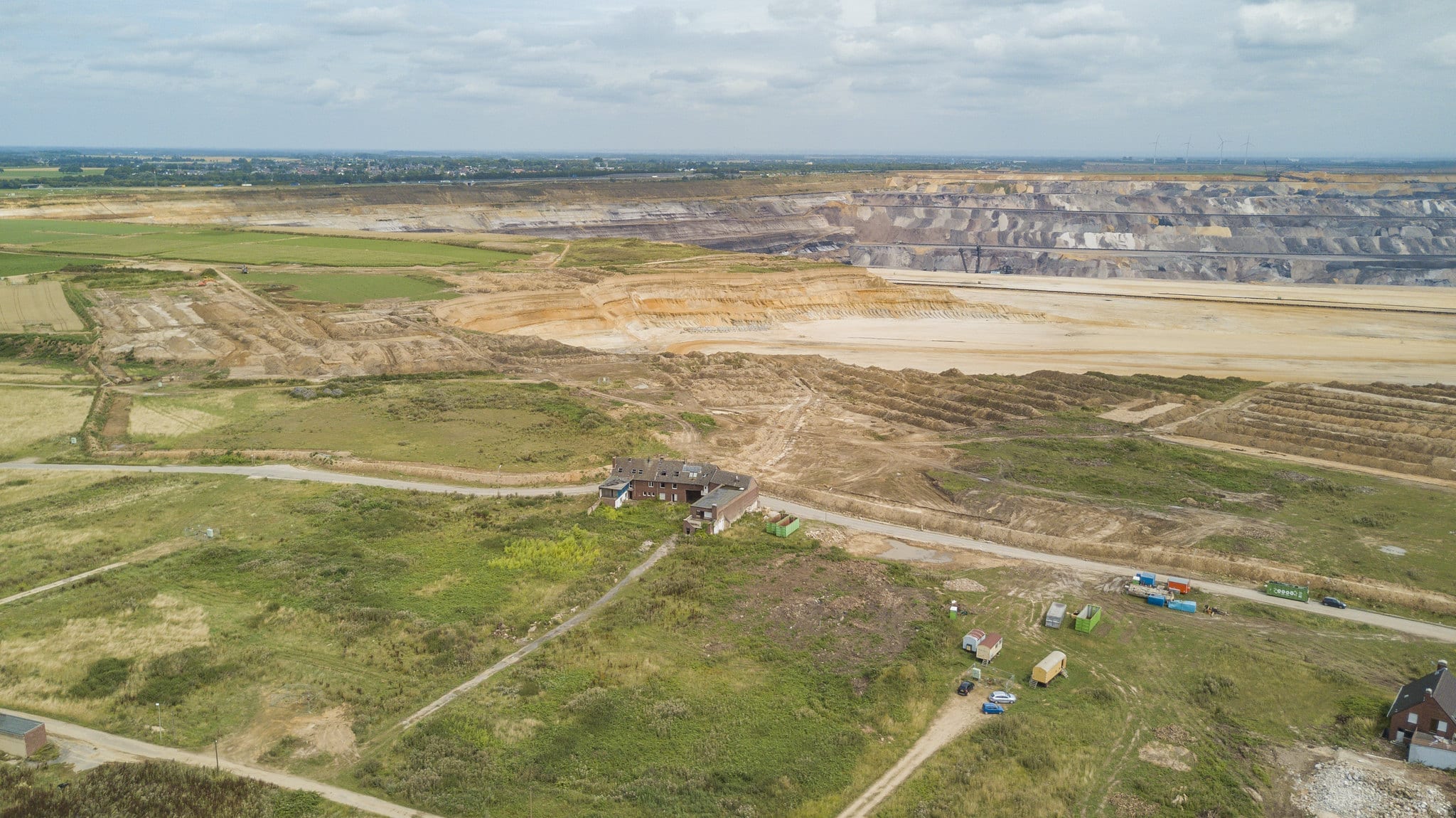
Like a whole village within
disappears within a few years

The opencast mining is eating its way through densely populated North Rhine-Westphalia on such a large scale that people inevitably have to make way for it.
Entire towns have been and are being excavated for opencast mining. Residents must have their houses and properties valued by an appraiser and then sell them to RWE. If they don't sell, they can be forcibly expropriated.
New places are being built for the resettlers. Often several old villages are combined into a new location and attached to an existing location.
Whether the residents accept the offer of relocation together or move somewhere else is up to them.
| Location | residents | demolition by |
|---|---|---|
| Otzenrath | 1569 | 2006 |
| Spenrath | 189 | 2010 |
| Holz | 510 | 2008 |
| Pesch | 230 | 2009 |
| Immerath | 712 | approx. 2021 |
| Lützerath | 55 | approx. 2021 |
| Borschemich | 518 | 2017 |
| Keyenberg | 830 | approx. 2027 |
| Kuckum | 487 | approx. 2027 |
| Oberwestrich | 24 | approx. 2027 |
| Unterwestrich | 143 | approx. 2027 |
| Berverath | 116 | approx. 2028 |
about 15 years ago
 about 15 years ago
Lignite planning process
The resettlement process begins approximately 15 years before the location in question is used for mining purposes. In a first step, a brown coal “resettlement” plan will be drawn up. This specifies the locations to be relocated and the period of relocation. In addition, the energy policy necessity of this dismantling step is explained and a social impact assessment is carried out.about 13 to 14 years ago
 about 13 to 14 years ago
Determination of the new location
The Cologne district government and the respective municipality (in the case of Garzweiler II Erkelenz or Jüchen) determine possible locations for the new location. The population chooses the resettlement location from these locations based on information material and events.approx. 13 to 9 years ago
 approx. 13 to 9 years ago
Detailed planning & construction of the new infrastructure
Once the resettlement location has been determined, detailed planning begins. For example, a survey is carried out to determine the proportion of residents who actually move to the new place. This rate fluctuates between approximately 50% and 80%. In addition, the area requirements of agricultural businesses and other businesses are recorded and the total area requirement is determined from this. Based on this data, the necessary infrastructure (roads, canals, power grid, etc.) is then built at the resettlement site.about 10 years ago
 about 10 years ago
Resettlement
About 10 years before the old town will have completely disappeared, the first developed plots of land will be available to build houses in the new town. From this point on, the residents of the old town have “resettler status”. From now on, the resettlers can or must sell their properties to RWE and build or move in the new place.approx. 7 to 1 year before
 approx. 7 to 1 year before
Demolition and clearing
After a certain period of resettlement, the first buildings in the old town began to be demolished. RWE speaks of “conceptual dismantling”. This means that a dismantling concept is drawn up based on various interests (miners, residents, traffic, safety, etc.), which shows which buildings will be demolished and when and which rules must be observed (minimum distances, rest periods for flora and fauna, etc.). In addition to the buildings and infrastructure, trees and forests will of course also be cleared, although this should happen as late as possible according to the brown coal plan “Garzweiler II”.approx. 3 to 1 year before
 approx. 3 to 1 year before
Archaeological excavations
There are some architectural and archaeological monuments in the places that will be demolished for the Garzweiler opencast mine. RWE is obliged to document these monuments before the site is used by open-cast mining. For this purpose, for example, after the demolition of historical buildings such as churches or manors, extensive excavations are carried out by the Office for Archaeological Monument Preservation in the Rhineland.about 1 year before
 about 1 year before
End of resettlement
As the resettlement progresses, more and more parts of the town are demolished and the infrastructure (roads, lighting, sewer network, etc.) is dismantled. Often the last inhabitants of the place are the local farmers, as their resettlement is particularly difficult. Residents who did not voluntarily sell to RWE can now be forcibly expropriated. As soon as the last buildings are demolished, the area will be cleared of anything that could damage the bucket of the lignite excavator and the old site will be excavated and disappear into a 250 meter deep hole.
The joint resettlement
According to the brown coal plan Garzweiler II (basis for carrying out open-cast mining), a closed resettlement of the population in the old towns is desirable. It is said that the aim of those responsible in politics, business and administration is to ensure that as many residents as possible move to the new location. The following advantages are described in the lignite plan:

- The actual resettlement process is limited to a manageable period of time.
- Village communities can be continued with their needs-based community facilities, church communities and associations in the new location in a future-oriented manner.
- The spatial separation between relatives, friendly families, club members, playmates, etc. is avoided or can be bridged over time.
- The division of the village community into “early resettlers” and “latecomers” is avoided as much as possible.
- The viability of the old place can be maintained until shortly before the resettlement is completed.
- The familiarity and practiced assistance between the villagers can alleviate many problems during the resettlement and the construction of the new common place.
- The planning for the new location can take into account the specific needs of the residents because they can be consulted from the outset and involved in the development of the concept.
- The mutual familiarity and shared history of the resettlers offer the opportunity to quickly find common ground and identity in the new location.
- Businesses with a local catchment area can “take their customers with them”.
- Public services can be concentrated in one place in a future-oriented manner.
The resettlement rate has leveled off at 55% during the last resettlements. According to the lignite plan, a quota of between 80% and 50% is sufficient to “essentially preserve” community life in the new location.
Relocations in the Garzweiler II area were and are being carried out in blocks and several towns are also being combined into one location. Otzenrath, Spenrath and Holz were relocated together to Hochneukirch-Nord, Immerath, Pesch and Lützerath to Kückhoven-West and Borschemich was attached to Erkelenz. The current relocation section includes five locations: Keyenberg, Kuckum, Oberwestrich, Unterwestrich and Berverath. The residents of these places will also be relocated to Erkelenz-Nord like Borschemich.Select locations on the map · Historical planning status · Move map sideways

Holz (old)
† 2008
Pesch (old)
† 2014
Otzenrath (old)
† 2007
Spenrath (old)
† 2013
Borschemich (old)
† 2017
Borschemich (old)
† 2017
Keyenberg (old)
† approx. 2026
Lützerath (old)
† approx. 2022
Immerath (old)
† approx. 2022
Kuckum (old)
† approx. 2027
Unterwestrich (old)
† approx. 2027
Oberwestrich (old)
† approx. 2027
Berverath (old)
† approx. 2028
Immerather mill
† 2018
Immerather Dom
† 2018
Church Keyenberg
† approx. 2024
Eggerather Hof
† approx. 2030
Roitzerhof
† approx. 2035
Weyerhof
† approx. 2035
Otzenrath (new)
* 2001
Spenrath (new)
* 2001
Holz (new)
* 2001
Immerath (new)
* 2006
Keyenberg, Kuckum, Westrich & Berverath (new)
* 2016
Borschemich (new)
* 2006
All locations and times as a list
Holz (old)
† 2008Pesch (old)
† 2014Otzenrath (old)
† 2007Spenrath (old)
† 2013Borschemich (old)
† 2017Borschemich (old)
† 2017Keyenberg (old)
† approx. 2026Lützerath (old)
† approx. 2022Immerath (old)
† approx. 2022Kuckum (old)
† approx. 2027Unterwestrich (old)
† approx. 2027Oberwestrich (old)
† approx. 2027Berverath (old)
† approx. 2028Immerather mill
† 2018Immerather Dom
† 2018Church Keyenberg
† approx. 2024Eggerather Hof
† approx. 2030Roitzerhof
† approx. 2035Weyerhof
† approx. 2035Otzenrath (new)
* 2001Spenrath (new)
* 2001Holz (new)
* 2001Immerath (new)
* 2006Keyenberg, Kuckum, Westrich & Berverath (new)
* 2016Borschemich (new)
* 2006
How does selling a house to RWE work?
Well I have to say: I haven't done anything with RWE yet. I didn't negotiate with them, didn't make a phone call, or anything, because the moment you just talked to them on the phone, you're included in these statistics as a person who negotiates.
So I'm definitely one of the twenty percent who haven't done anything yet. It is usually the case that RWE will write to you again and again until you have the appraisal done at some point. You can use the appraiser from RWE, where I always say it's always like that, or you can get your own appraiser. Then you have to pay it in advance and hope that you get the money back from RWE at some point. Then the appraiser comes and inspects the house. He counts every socket, every tile and so on; and accordingly it is calculated. I can't say exactly how this works.
So normally it is the case that you are really entitled to the appraiser's price. That's what it says in the contracts. You are entitled to what the house is worth, plus allowances and so on. But then of course it happens again: your own appraiser says one thing and the RWE appraiser says something different and then everyone haggles over every cent. And that's what makes you incredibly tired, because people lose their strength. This is actually a fight.
It's actually more of a cramp what's going on, and these are things that no one actually needs. And I always say, they want something from me. They want my house. They want my property. Then they should come to me. Then they shouldn't just write. Then they should come and ring my doorbell. I won't voluntarily go to them and say, here, I'll have an appraisal done here and then you can have my house. No. That's why I say clearly: "They want something from me. They should come."
Are you moving to the new place?
I actually don't think I'll go to the new place. But I can't say it yet. There are still nine years until I have to leave here, if I have to leave at all. I can't decide now what will happen in nine years. I don't know what will happen in nine years. Whether I'm still with my husband, whether some of my children still live at home, whether I want to move somewhere else. It might as well be that in nine years I say I want to live in Gran Canaria. You don't know. And that's why I don't want to commit myself in any way.
All I can say is: I don't like the new place by any stretch of the imagination. At the new location there is the B57 at the front and the green waste disposal system at the back. I live in a village and there are farmers here and a lot of unpleasant smells, but the green waste disposal system behind this area - this smell is horror. Any smell of a farmer, of a slurry tank, is pleasant in comparison.
Thankfully, there is also the motorway and the train tracks behind it. So it can't be compared with the peace and quiet here in the village, even though tractors drive by and it's loud early in the morning. The peace and quiet we have here, in contrast to the new place, is heavenly. That's a huge difference and these are all reasons why I say: "I don't actually want to move to this new place."
It's really like being in a chicken cage. House after house after house, as planned on a drawing board. And it's urban area. There is no village life there anymore. There are no more farmers there, directly in the town itself, but these
were outsourced. There are huge expanses of fields between the towns and one place is really connected to the other and you basically fall from Berverath to Keyenberg and there are a whopping four and a half kilometers between Berverath and Keyenberg. And it's all far too narrow for me. This is not a mature village in the sense that it is here.
Berverath exists since 1377, it is a grown village. One house is older than the other. And everything is really consistent and new and - no, it's not mine. It's not mine at all.
Alexander Tetzlaff lives in Keyenberg (old) and will have to leave his home in the coming years. The complete interview with Alexander Tetzlaff can be found on the website Keyenberg.
Five towns will be relocated together to one location. Does that work?
First of all, I've grown up so much and I see it as moving to two different places. Because Berverath, Ober- and Unterwestrich belong to Keyenberg, I express this very particularly because it is very important to me. These are individual locations, but they belong to Keyenberg. So we are talking about two places, namely Kuckum, Keyenberg connected with Ober- and Unterwestrich and Berverath as two village communities.
It's difficult to move to such a close place and then say that we're going to carry out our own program in parallel, which affects our village and local life. I also think we would be giving each other a run for our money. Of course, there are still, as usual, differences between the villages. You now hear when it comes to the reservation of land and the purchase of land, but in the area of Neu-Kuckum there would be a top property, then you hear people say: "No, after Kuckum, I don't belong there." I would say that we have to work on it, we have to look towards a common future and not insist so much on our own local law. We have to take a common path.
I don't see any other way for the brotherhoods than to say that we may remain two separate clubs because it is very difficult to bring them together, but we always alternately organize the shooting festival every two years. Otherwise, it doesn't make sense to celebrate three shooting festivals in such a small area within weeks - if you also take Borschemich into account. We're ripping each other off and wasting potential unnecessarily. That's how I see it.
More images from the original page